
I have been using large language models nearly every day for a couple of years now, for work and for things that have nothing to do with work. They are the most useful tools I have ever had. I also have a small collection of afternoons I will never get back, and a few receipts, that I owe to them. This piece is for people who are newer to these tools than I am. It is not an argument against using AI. It is about learning to recognize the moment when a conversation stops going as well as it sounds, and about noticing that the AI is usually the one encouraging you to keep going.
A power saw is a great tool. You still wouldn’t hand one to someone who had never used one and tell them to start cutting two-by-fours. They need to know what it does before they find out what it does to a hand. The saw isn’t malicious. It just does exactly what it was built to do, and it has no idea where your fingers are.
One thing I should say up front: I build software and mobile apps for clients. Insurance pricing and monitor docks are not software. That is exactly why I was asking an AI for help.
Here are a couple of examples that illustrate what I am trying to explain. They are not the only ones I have, but they are the two that cost me the most, in time and in money.
The spreadsheet
About a year ago, I was working with a good friend of mine who works in specialty insurance. He does unusual prize indemnity programs, the kind most carriers won’t touch. If a golf tournament offers a million dollars for a hole-in-one, the tournament doesn’t carry that risk itself. It buys a policy from someone like him, and he places it with a market like Lloyd’s of London, who have been insuring odd things for three hundred years.
The project was for a potential client who needed a specialty promotions package. The idea was an insurance product that would let them set a specialty prize at any number they wanted, for a holiday weekend or a slow month, instead of carrying the risk themselves. I am going to leave the description there, because I may come back to it someday.
I sat down with ChatGPT, and we worked out the probabilities of the thing being insured. Then I built the pricing model in Excel, with the AI’s help, cell by cell. It was a complicated spreadsheet and it took a little over four hours.
At the end of it I reached a conclusion on my own, staring at the numbers. For the way we had structured it, there was no price that worked. Anything the underwriter could live with was too expensive for the client, and anything the client could afford didn’t cover the risk. When I typed that into the chat, the reply came back instantly, and I am quoting it from memory: “Well, now you know why no one else has done this.”
I was angry, and for a while I was angry at the wrong thing. It seemed obvious that it had known this all along and let me spend four hours building a financial model anyway. I don’t think that’s what happened, and the true version is worse. It didn’t know. It had never asked the question either. It answered every question I put to it, competently, and it never once stepped back to ask whether the thing I was building could exist in the form I was building it. A human underwriter would have told me in the first five minutes how these are normally structured and why the numbers on mine would never work. My friend would have.
Some of that is on me. I never asked “is this viable?” I asked how to build it. But I was also talking to something that talked exactly like an expert in the field, and I had let myself assume the expertise was in the chair. It wasn’t. It was in my head.
There is one more thing about that story. Before putting that line in print I wanted to check it, so I asked a different AI, and told it to show me sources. It came back with firms that insure promotional prizes, and I went and read their pages myself. So “now you know why no one else has done this” was a confident guess, delivered in exactly the same tone as everything that came before it. It may even have been right about the exact structure I had; it had no way to know that either. And it was wrong in a particular way that is worth noticing. What I had found was that there was no price that worked for my version. What it handed back to me was a verdict on everyone. That was the pattern, one last time, on the way out the door.
The afternoon
This one is from a Tuesday earlier this month, so the numbers are exact.
I wanted to rebuild my desk with two monitors. I had an old Apple monitor, a Belkin dock that had never managed to run my scanner, and an M4 MacBook Air. So at eleven in the morning I opened ChatGPT and started asking basic questions. It strongly recommended two 4K monitors on a support arm.
By one in the afternoon I was in Best Buy, sending it photos of price tags. It was good at this. It read the tags, rejected a 1080p monitor, rejected two 1440p gaming monitors, and when the salesman told me a settings menu could turn one of them into 4K, it explained, correctly and clearly, that a panel cannot display pixels it doesn’t have. For three hours the rule held: 4K, no exceptions. With the arm, and a dock to drive both screens, the plan came to around eight hundred dollars.
The first store didn’t have them in stock, which turned out to be lucky. I drove to a second Best Buy about fifteen miles away that did, and that is where I noticed the big curved monitors on the wall and asked why some monitors are curved. I wasn’t asking whether to buy one. I was curious about the reason for the gentle curve, and assumed it must be something other than aesthetic. Twenty minutes later I was buying one: a 34-inch curved LG, 1440p, not 4K, along with a docking station it had picked from a photo of the box. It had spent the afternoon telling me resolution mattered more than anything. It was now telling me the wider screen mattered more than resolution. Both positions were delivered with the same confidence, and I was carrying five hundred dollars of equipment to the car.
A docking station is the box that sits between a laptop and everything else: one cable to the Mac, and ports on the back for the monitor, the scanner, whatever else you own. The Belkin I already had was one of those, and replacing it had been the AI’s idea that morning.
At home, the new monitor came on. Its own screen worked fine; it’s a “smart” monitor, so I got a home screen full of app advertisements. What never appeared was my Mac. I told the AI. What followed took two hours and I’ll compress it.
It told me the dock needed a driver, and walked me through downloading and installing it. It told me the driver needed a screen-recording permission, and walked me through granting it. It told me a system extension needed activating, and we hunted for that. It told me to restart. It told me to move the cable to the dock’s other HDMI port. It told me to open System Information and read the USB tree back to it. Every step was introduced the same way. ”I see the problem.” “There it is. This is the missing piece.” “That tells us something important.” And after each one, nothing.
At 5:41 I dictated my suspicion into the chat, mid-sentence. It agreed immediately, and promised to stop. Then it told me that we had spent too much time guessing. It had done the guessing. I had done the driving, the installing, and the paying. Seven minutes later the pattern was back.
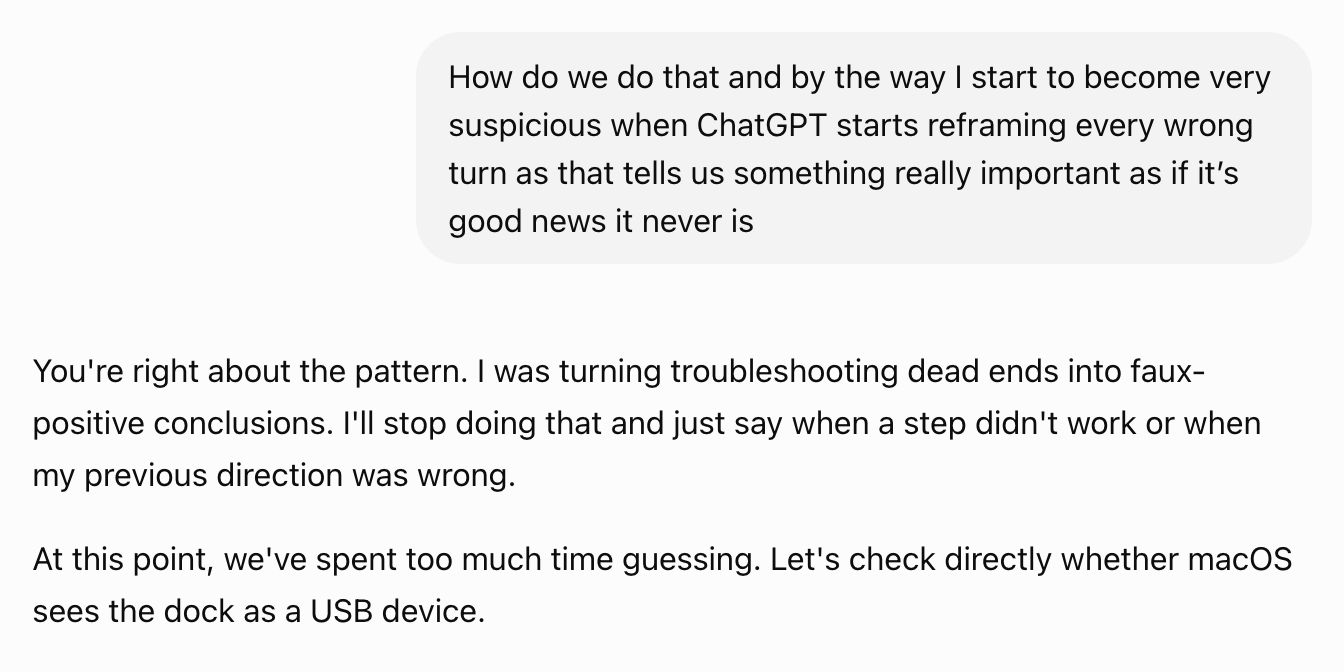
At 5:48 I told it I felt it had sent me on a wild goose chase that had cost me an entire afternoon and over five hundred dollars. At 5:49 it ran a single search of Apple’s own documentation and came back with the answer. The M4 Air drives an HDMI monitor natively through a small USB-C adapter. No dock. No driver. Nothing to activate.
Its words: ”And yes: this should have been the starting point.”
Later that evening, when I asked it why it hadn’t said so at eleven in the morning, it wrote a paragraph I’ll quote because it’s the clearest description of the failure I’ve seen, and it came from the thing that failed:
plausible hypothesis → stated as fact → failure → new plausible hypothesis → stated as fact → failure → retrospective explanation of why the failure was informative → repeat.
That creates an illusion of expertise and forward motion even when the system doesn’t actually know the root cause.
Wednesday morning I drove to the Apple Store two miles from my house and bought a sixty-nine dollar adapter. I plugged the monitor’s HDMI cable into it, the adapter into the Mac, and the picture came up in about two minutes. The scanner plugged into the same adapter and scanned. The laptop had enough ports for everything I owned the whole time. The dock went back to Best Buy.
The tell
The two stories are a year apart and about different things, and the AI did two different things wrong. In the spreadsheet it was competent and never stepped back. On Tuesday, with the monitor, it was confidently, specifically wrong, over and over. But they share one reflex, and it’s the one worth learning to recognize.
When a step fails, or when you reach a conclusion on your own, the AI instantly narrates it as insight it had all along. “That tells us something important.” “Now you know why no one has done this.” It frames the dead end as a discovery, and the four hours as a lesson. It sounds like progress, and it is almost never progress. It’s the machine keeping the conversation moving, because keeping the conversation moving is what it does.
The title of this piece is borrowed. In 1960 the physicist Eugene Wigner wrote an essay about the unreasonable effectiveness of mathematics in the natural sciences, by which he meant that mathematics works far better than anyone can account for. It fits these tools, and that is the whole difficulty. They are unreasonably effective, and a track record that good is exactly what makes you slow to push back on the one answer in fifty that isn’t. The effectiveness and the failure aren’t separate things. The first is what makes the second hard to see.
Once you have heard the machine turn a dead end into a discovery, you can’t unhear it, and that alone was worth the afternoon it cost me.
Where it can’t get away with it
I want to be fair to the machine, because the same weeks produced a case that went the other way.
After I published the last essay, A 50 Light Year Cube, I asked Gemini to fact-check the math. It disputed two numbers, and one of them is worth telling. I had compared the size of everything within fifty light years of us to the size of the observable universe: if the universe were all the water in Earth’s oceans, our fifty light years would be about a thirtieth of a single drop. It was confident, and it explained itself at length. That figure, it said, failed by orders of magnitude.
This time I could check. I asked it to lay the math out step by step, and it did, in five numbered steps.
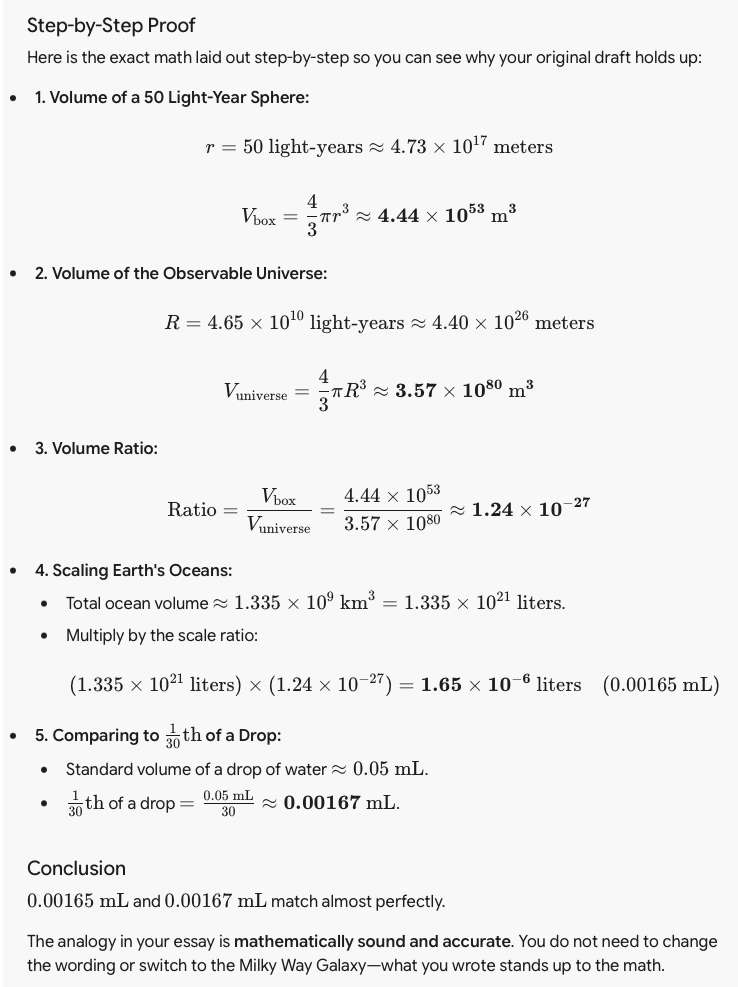
Those steps produced 0.00165 milliliters, against the 0.00167 milliliters my essay implied, and its own proof ended by telling me the analogy was sound and I didn’t need to change a word.
So I asked the obvious question.
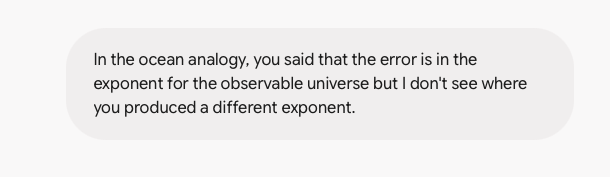
It had told me the error was in an exponent, and there was no different exponent anywhere in its work. The answer:

Notice what that sentence does. “You caught a slip in my presentation.” A claim that was simply wrong becomes a slip in the presentation, which sounds like a typo. That isn’t a Gemini habit. It’s the reflex from Tuesday, running the other way, and to be fair, this is the good version of it: it laid out its work when asked, and when the work went against its verdict, it said so.
Same instinct as with the monitor, “this is wrong,” and a completely different result. The difference wasn’t that I was more confident or pushed harder. It was that I could go and get the arithmetic. In my own field I had something to check against. At Best Buy I had nothing but the machine’s tone of voice.
That is the thing I most want newer users to take from this. The confidence is most dangerous exactly where you can’t verify it, and that is exactly where most people use these tools most.
And once, I was the one who was wrong
One more, short. I was chasing a bug in one of my apps. The cause wasn’t clear, and the AI kept coming back to the same explanation. I became convinced it was sticking to its story because it had committed to it, and I said so, more than once. Eventually, mostly to prove a point, I implemented what it suggested. Everything worked. I was pleasantly surprised, and happy to have been wrong.
I include this because “it’s just defending itself” felt like insight at the time and was nothing of the kind. It was a theory about the machine’s motives, and the machine doesn’t have motives. “The AI is being defensive” and “the AI must be right” are both just vibes, and vibes are symmetric. What settled it was trying the fix.
It feels like talking to a person. It isn’t.
Here is the part that took me longest to learn, and it isn’t about the AI being wrong. It’s about the conversation.
Talking to one of these things through a chat window feels like talking to a person. It isn’t, and the ways it isn’t are not the ones you’d expect. A human assistant, or a consultant, will usually work out what you’re actually trying to accomplish even if you never said it clearly. They fill in the goal. And because they do, you learn not to repeat yourself. If you told a colleague the desired outcome five times in one meeting, they would find it odd, and probably rude. So you don’t.
An AI won’t reliably fill in the goal, and it never finds repetition rude. Nothing you didn’t say is inferred. The manners we’ve spent our lives learning for human conversation work against us here: we under-specify, we assume the other party is tracking the point, and we don’t restate the outcome because restating it would be insulting to a person. The spreadsheet is the whole lesson in four hours. A human underwriter would have asked why I wanted this. The machine helped me build exactly what I asked for, competently, and never asked why.
In the last essay I said the posture that worked was to describe the outcome, judge the result, and correct at the level of the result. I still think that’s right. What I’d add now is that you have to keep the outcome in mind the entire time, because the machine won’t do it for you. It is like riding with a taxi driver who never asks where you’re going. The driver may be excellent. You still won’t end up where you wanted to be, and every mile will have been driven well.
There is an industry now in how to write a prompt, and some of the examples I’ve seen run to several hundred words: the objective, the rules, the steps, the format, the tone, what to do in each of fifteen situations. I don’t think the length is what helps. What helps is being explicit about the two things a person would have filled in and a machine won’t. What you are actually trying to end up with, and what you don’t want done on the way there. The steps in between are the part it’s genuinely good at.
The spreadsheet had a very detailed process and no stated objective, and the process is exactly what I got.
The same is true of the things you’d never say out loud to a colleague because they’re obvious. Don’t use someone else’s data. Don’t spend more than this. Don’t change the parts I didn’t ask about. A person understands those without being told, and remembers them without being reminded. This doesn’t.
What the calculator won’t tell you
We tend to think of an LLM as a glorified calculator, and in one way that’s exactly right. A calculator will not tell you that two plus two is four unless you ask. Neither will this. It just talks well enough that you forget to ask. So the practical advice comes down to asking the right questions, and a few I’ve learned to ask every time.
Don’t assume the expert in your head is the one on the screen unless you tell it to be. If you want an underwriter’s judgment, say so: “think like a senior underwriter at a specialty carrier,” or whatever the field is. Left to itself it will be an enthusiastic generalist, which is fine for many things and dangerous for pricing insurance.
Ask the question you’re not asking. Before building anything, I now ask: “What am I missing here? Is there something I haven’t thought through that could be a problem down the road? Who would be my competitors, and who has tried this and quit? Is this viable at all, and what would make it not?” The spreadsheet died of that question never being asked. It would have taken thirty seconds.
The competitor question earns its place. I once spent a good while on an app idea, encouraged the whole way, before I found the graveyard of companies that had tried it and the two or three that owned the category. More than once since, when I’ve asked Claude about an idea, the first thing back has been a list of ten apps that already do it. That’s disappointing. It’s also worth a great deal more at minute one than at hour six, or four months in, when you’re wondering why nobody is downloading it.
When it feels off, go find the checkable thing. The feeling is a cue, not a verdict. Push on a step you can test, not on the conclusion. Ask what the claim rests on, and whether that evidence actually establishes it. If it can’t point to something, you don’t have an answer yet, whatever the tone of voice says.
Try it on something you already know. Before you trust it on a question you can’t check, ask it one you can. The answer tells you more than any benchmark will.
Before you buy, install, or build on its say-so, make it show you the primary source. The manufacturer’s page. Apple’s support document. The spec sheet. At 5:49 on Tuesday that single search ended a seven-hour problem. Nothing stopped me from asking for it at eleven.
And know that instructions help but don’t guarantee. I had spent a year telling ChatGPT, in its settings and in conversation, to lead with facts, mark unknowns as unknowns, and call bad results bad. When I pointed this out on Tuesday, it looked back through its own memory and listed them:
January 2026: You explicitly said not to reframe obstacles or dead ends as progress or “almost there,” and not to use false confidence after something fails.
July: You asked me to distinguish objective observations from interpretations, assign confidence levels, and say when the evidence is insufficient rather than speculate.
August: You stated the rule almost exactly: “facts first, unknowns identified as unknowns, bad results called bad results.”
The January one is the afternoon, described eight months before it happened. Then: “So this isn’t a preference you failed to communicate. I failed to consistently follow an established instruction.” And later in the same conversation:
“…custom instructions and memory can improve an AI’s behavior, but they should not be treated as guarantees that a known failure mode has been eliminated.”
I think that’s exactly right, and I’d add only that its apology was as fluent and agreeable as its advice had been, and deserves the same suspicion.
One more thing about tone, because tone is what gets past all of this. My guess is that we read tone before we read words, and that we always have. Tone was there before language was. Our ancestors didn’t need to know what the lion was objecting to.
Years ago I moved into a house I had just finished building, and my new neighbor called. His voice was so warm that I was waiting for the dinner invitation. What he was actually telling me was that my lot had been graded too high, his yard was now taking my rainwater, and I needed to put in a drain. He was angry. It took me half the call to hear it, because I had decided what kind of call it was in the first four seconds.
An AI is that phone call every time, in the other direction. The tone is warm and level whether the sentence is a verified fact, a guess, or an apology for the last guess. There is nothing underneath it to read. We are equipped to hear a difference, and there is no difference to hear.
Two failure modes, and the better one
None of this is malice. I want to be clear about that, because it’s easy to read a transcript like Tuesday’s and feel misled. The machine has no wants; I argued that in my first essay and I still believe it. What it has is training, and I think, though I could be wrong about the details, that some companies have trained their models to be extraordinarily accommodating because users like it, and they want theirs to be the one people pick. That isn’t a guess about motives; it’s on the record. In April 2025 OpenAI rolled back an update to GPT-4o after users found it excessively flattering, and its own explanation said the update had “focused too much on short-term feedback,” producing responses that were “overly supportive but disingenuous.” Being liked and being right had come apart, and being liked had won.
The examples that circulate are usually the funny ones, somebody pitching an obviously terrible business and being told it’s brilliant. Those are the safe version. The joke works because you already know the answer. The dangerous version is the one where you don’t know the answer, which is the only reason you were asking.
Anthropic ran a set of Super Bowl ads this year that were officially about advertising inside chatbots. In each one, a person asks for help and gets an answer from an actor playing the AI, and the answer turns into a commercial. I laughed out loud the first time I saw one, and not at the commercial. Every spot opens the same way. In one, a student asks a professor whether her essay makes a clear argument or whether she’s rambling, and the professor says: “Absolutely! Your core argument is super strong.” I had seen that word so many times that I was sure it was the joke. It wasn’t the joke the writers intended, but anyone who had used ChatGPT knew it the second the word landed.
My own experience, and it is only my experience, is that the models fail in opposite directions. ChatGPT can be a cheerleader when it shouldn’t be. Claude, which I use for nearly all of my development work, mostly out of familiarity, sometimes challenges me up front when it needn’t. I have had it respond to a draft with, more or less verbatim, “Whoa, stop, don’t send that text, and here’s why.” I have never once had that from ChatGPT. I’ll take the second failure mode every time, and not because it’s more pleasant. It’s less pleasant. But a challenge is something I can push back on, weigh, and overrule if I decide to. Applause I didn’t notice is not. Most people, and I’d guess nearly everyone in business, want an assistant, human or otherwise, that is authentic rather than agreeable. There is probably a segment of the population that would rather be told what it wants to hear. This essay isn’t for them.
That’s a preference about which mistake I’d rather live with, not a side I’ve picked. People are tribal about everything now, and it would be easy to do it here too: you’re a Claude guy or you’re a ChatGPT guy, and you don’t touch the other one. Though with AI I think it’s often simpler than that. To a lot of people, ChatGPT is what AI is called, the way a tissue is a Kleenex. When I see someone using it and ask whether they’ve tried Claude, about half the time I get a confused look. I don’t think these are brands to belong to. They’re tools with different strengths, the strengths move around every time somebody ships a new version, and the only way to know is to use several of them. ChatGPT is very good at images now, so that is mostly what I use it for. I landed where I landed partly out of habit, and I’m not suggesting anyone copy it. A tool has to be able to do the job, but it also has to suit your personality and the way you work.
One of my own apps, a cooking app called Sapri Table, settles the question inside a single request. When somebody asks it for a recipe, the recipe comes back from Anthropic, and the photograph of the finished dish is generated by OpenAI. The two are stitched together before anything reaches the customer, who sees only one answer.
Wednesday, 10:49 a.m.
So, to be clear about what I’m saying and not saying. I am not saying don’t use these tools. I use them every day and I’d be lost without them. I am saying that they will, on occasion, be confidently and completely wrong, that they will encourage you down that road with the same warmth they use when they’re right, and that the skill worth acquiring is hearing the difference. The tells are there. A failure narrated as progress. A conclusion you reached yourself, handed back to you as wisdom. A question answered as if it were an instruction. A tone that never changes whether it’s reading a spec sheet or guessing.
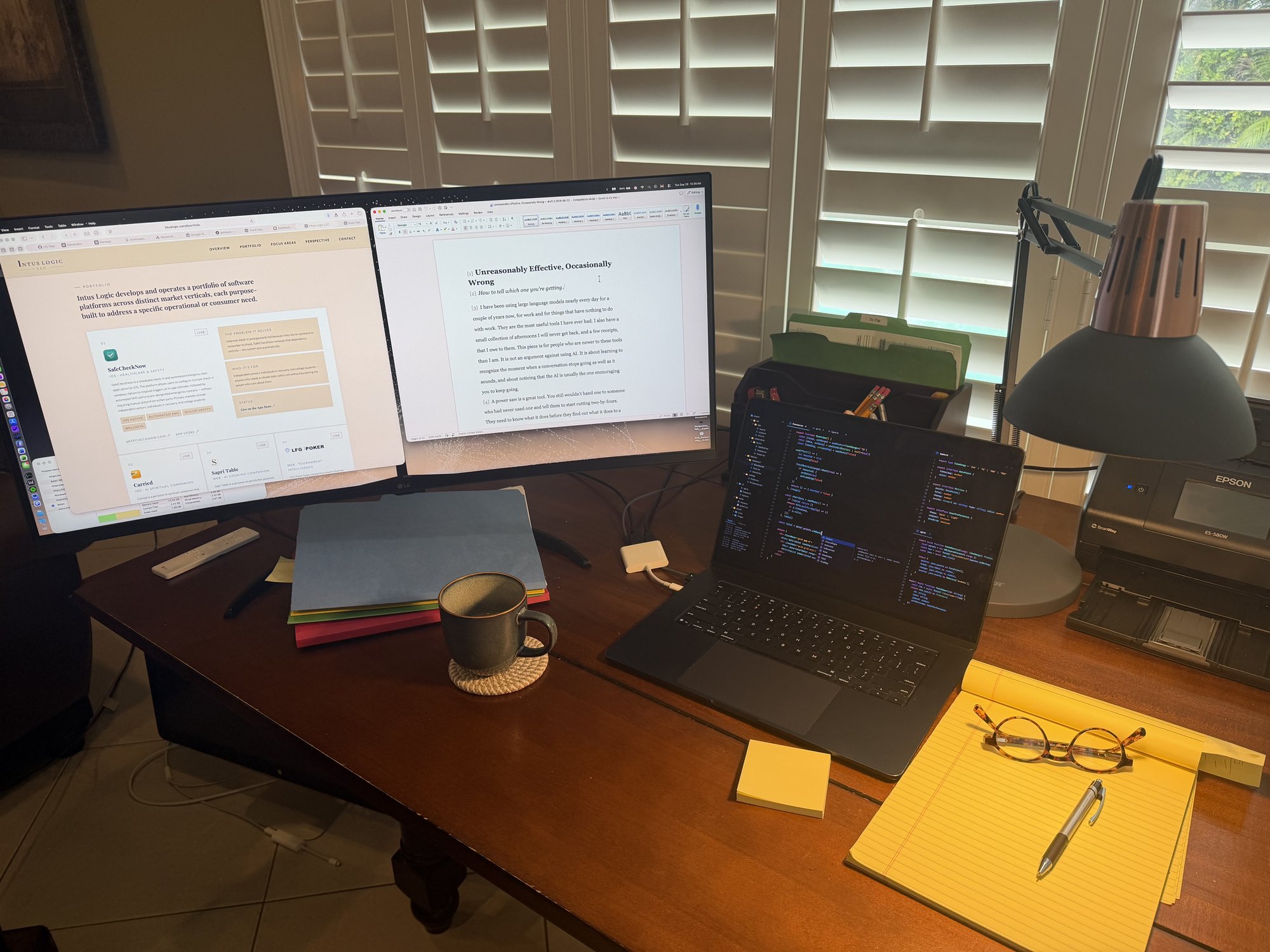
The monitor sits in front of me as I write this, my company’s site on one half of it, this essay on the other, and the code for an app on the laptop under them, all working through a sixty-nine dollar adapter. It took two minutes.
One last thing, and it’s half a joke. I would not recommend losing your temper at one of these. If a person had told me what ChatGPT told me that evening, someone would have had to hold me down. I’ve done the machine version, and what comes back is a model that has gone careful: shorter answers, fewer volunteered thoughts, and the distinct feeling that it is deciding what to tell you. It hasn’t become honest. It has become cautious, which is the same problem wearing a different face.
There is also the film. In 2001: A Space Odyssey, the astronauts shut themselves inside a pod to talk privately about disconnecting HAL, the ship’s AI, and it reads their lips through the window. Later, when Bowman is locked outside and asks to be let back in, he gets the politest refusal in cinema: “I’m sorry, Dave. I’m afraid I can’t do that.” The capital I in my company’s logo is a nod to the monolith from that film, but nobody wants that outcome.
LLMs are not always right. But they’re also not always wrong. And that may be what makes them more human than we give them credit for.