Every so often I get an email that ends with a question that wasn’t meant for me. It’s the AI, still talking to the person who asked it for help, asking whether the message should sound more formal or more casual. That question was supposed to stay between them. The sender copied the whole thing, pasted it, and hit send without reading to the bottom.
I understand why people are suspicious of AI at work. Emails like that one earn the suspicion. What I don’t think they earn is the conclusion a lot of people seem to draw from them: that if you used AI, the work isn’t really yours.
A study published this fall puts a number on that reaction. A team that included researchers at the Hebrew University of Jerusalem ran a series of experiments in which people played the role of a supervisor. In one, the supervisor had to decide whether to take an employee’s word for how long a task had taken, or check it. When they knew the employee had done the task without AI, they took the employee’s word 68 percent of the time. When they knew AI had been used, it was 24 percent.
Think about what that means. The AI had nothing to do with the time report, and the supervisors weren’t judging the quality of the work either. Knowing that someone had used AI was enough to make them seem less honest.
I think that comes from treating AI as all or nothing. Either the AI did the work, or you did. There isn’t much room in that picture for what most people who use these tools well actually do, which is somewhere in the middle, and usually a lot closer to the person than the machine.
The conductor
A builder who uses a bulldozer and power tools, and hires electricians and plumbers to do their part, still built the house. Nobody argues about that. But the image I keep coming back to is a conductor.
A conductor doesn’t play the violin, or the oboe, or the timpani. The orchestra does. But nobody walks out of a concert thinking the conductor didn’t have much to do with it. The conductor chose the piece, decided how it should sound, and spent the rehearsals listening for the section that came in a little flat or a little early, and fixing it. The music is the conductor’s, even though the conductor didn’t play a note.
That’s how I use AI to build software. I don’t type “build me an app that does this” and ship whatever comes back. I decide what it should do, I read what it produces, I test it piece by piece, and I send a lot of it back. Like people, AI doesn’t always understand exactly what I’m aiming for on the first try. I also change my mind along the way, sometimes adding to what the product will do and sometimes cutting things I’ve decided it doesn’t need. The tools play most of the notes now. Deciding what the piece should sound like, and hearing when it doesn’t, is still my job.
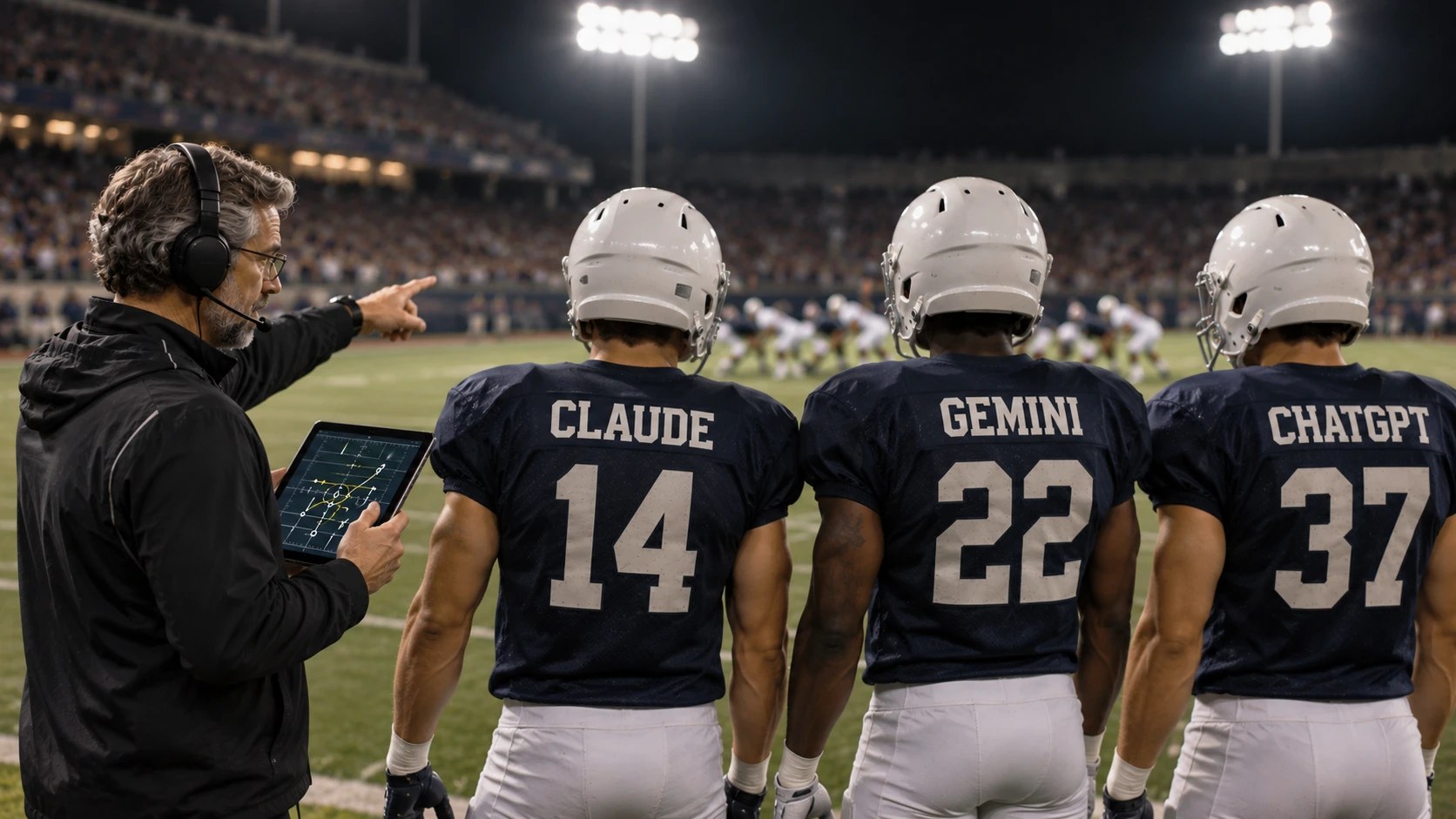
It also isn’t one AI. I use several, because I’ve learned that they have different strengths and weaknesses, and part of the job is knowing which one to hand which part of the work. It’s the builder again, deciding not only whether to hire an electrician but which one. These days it’s starting to look less like a builder hiring subcontractors and more like a football coach deciding who’s on the field for the next play. That kind of judgment comes from experience. Some weeks I spend half a day just trying new AI tools to see what they can do and how they feel to work with. Every so often one earns a place in the toolkit. It’s what I called the scientific method in an earlier essay: fuck around and find out.
A conductor can hear a wrong note because a good conductor knows the music. The obvious objection is: what about the parts you don’t know? I think the answer is the same one we use with people. When an employee or a contractor explains something outside my expertise, I don’t just accept it, and I don’t throw it out either. Often my reaction is something like, that sounds about 80 percent right, and I need to figure out which part isn’t. Sometimes I’m wrong, and the part that bothered me turns out to be fine. That happens with AI too. It doesn’t change the job. (I wrote about how I go about checking in an earlier essay.)
A spreadsheet
Here’s a small example. Recently I downloaded a report as a CSV file, the kind of plain export most business software produces. Everything was there, and it was very hard to read: cramped columns, labels like “days_overdue,” amounts with no dollar signs. I wanted to send it to a client, so I asked Claude, which now works inside Excel, to make it presentable without changing any of the data.
It did. A title, readable headings, dollar signs, dates spelled out, colored status labels, and overdue invoices in red where they’re hard to miss. It took about a minute. By hand it would have taken me 20 minutes or so. That isn’t much on one small report, but bigger ones, with several sheets tied together by formulas, get complicated fast. Then I checked that every number had come through unchanged. They had.
That’s a use of AI people don’t talk about much. I didn’t ask it for anything I didn’t already know how to do. I asked it to do something I knew how to do, faster. My guess is that someone who starts using AI that way, before it teaches them a single new thing, will get a lot more done in a day.
The pictures below are a mock-up with invented clients, because I’m not going to publish anyone’s real numbers. It went through exactly the same steps.
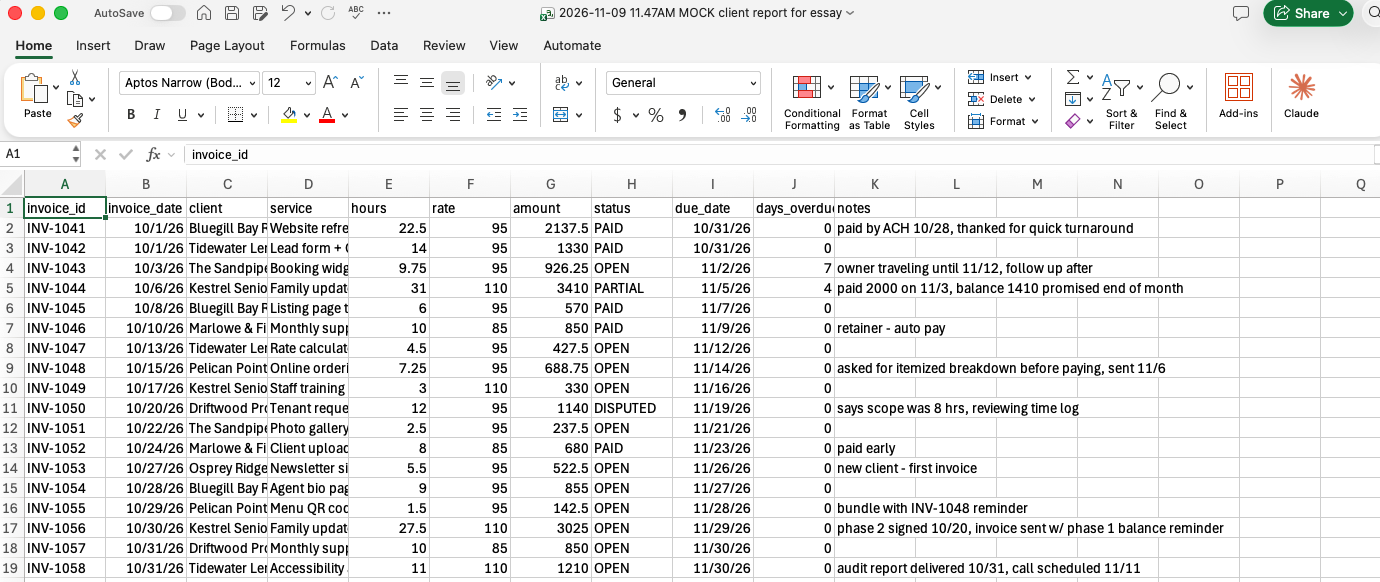
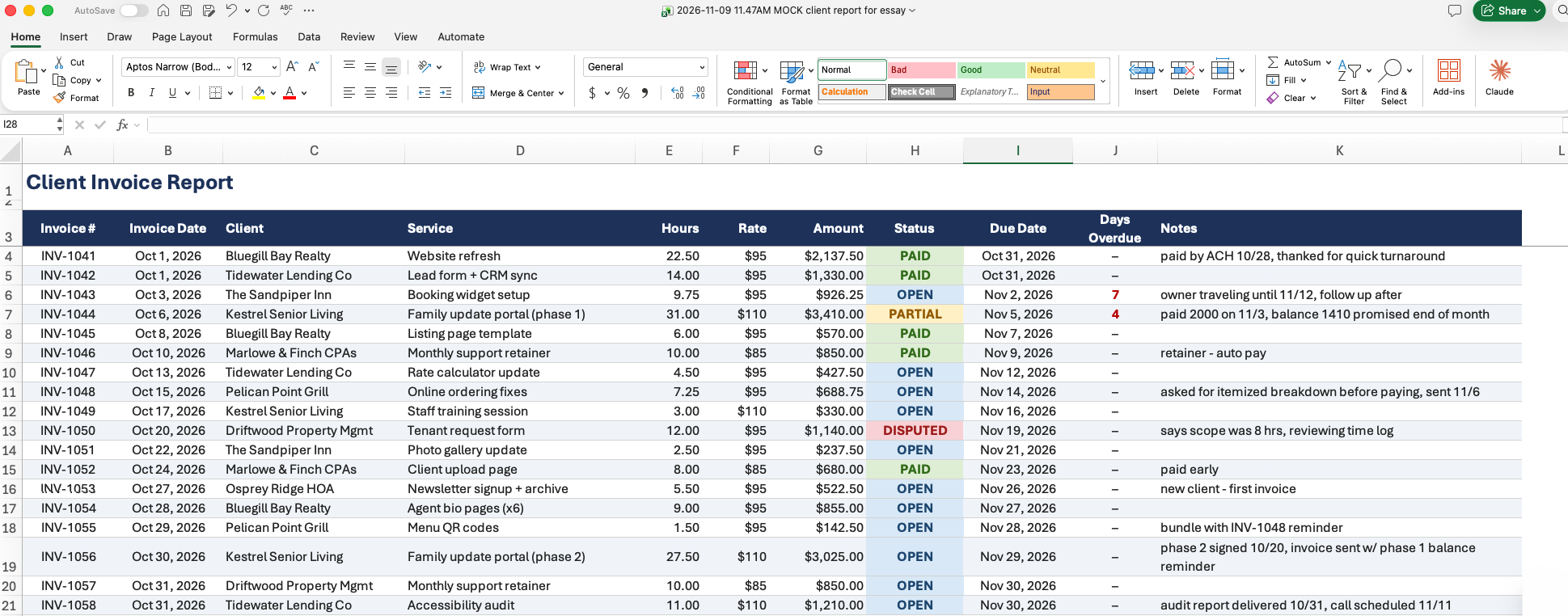
So did I use AI on that report? Yes. Did it write the report? No. The data was mine, the decision to send it was mine, and checking it was mine. The AI made it easier for my client to read, which is a favor to them. If my client’s boss heard “he used AI on that,” the study suggests they’d trust me less. I don’t think they should.
Where the line actually is
The person who sent me an email with the AI’s question still at the bottom and the person who had AI format a report and then checked it both “used AI.” That phrase isn’t telling us much. The more useful question is whether someone was paying attention.
There’s a hopeful part of the study, too. When the organization had explicitly encouraged employees to use AI, the trust penalty was much smaller, small enough that the researchers couldn’t be confident it was there at all. It was strongest when AI was banned, or when nobody had said anything either way. My guess is that a lot of this suspicion comes from not knowing what the rules are, and fades once people are open about how they use it.
So I’ll be open about it. I used AI to help write this essay. The ideas and the examples are mine, and so are the decisions about what stayed, what went, and what was added. Between the first draft and this one, about 27 percent of the words changed. Like the conductor, I didn’t play every note. It’s still my music.
Header image created with ChatGPT. The spreadsheet is a mock-up with invented clients.