More Americans object to a data center in their area than to a nuclear power plant. Gallup asked about both this spring: 53 percent opposed a nuclear plant, and 71 percent opposed an AI data center. A warehouse full of computers is now a harder sell than a reactor.
In the late summer of 2025, 42 percent of Americans told one polling firm they would oppose a new data center being built near where they live. This August, 75 percent did. Over the same stretch, the share who said they would strongly support one fell from 13 percent to 4. Gallup’s 71 percent is nearly the same number, and almost half of everyone it asked were strongly opposed. I can’t think of many issues where public opinion has moved that far, that fast, in either direction. The most recent poll, from late October, suggests it has finally leveled off, at around 70 percent.
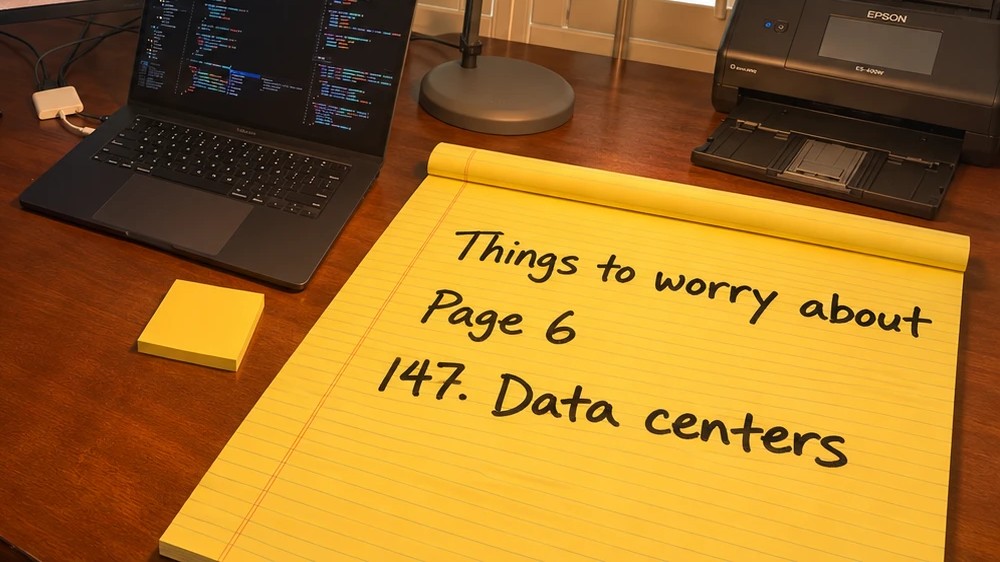
I think a lot of people have picked the wrong side of this one. That’s a contrarian position right now, and I know it. But of all the things we need to worry about as a country, I don’t think data centers belong anywhere on the first five pages.
I should say where I’m coming from. I build software and mobile apps for a living, and I use AI tools to do it nearly every day. Every product I’ve ever shipped runs on servers in a data center somewhere. So I’m not a neutral observer. I’ve tried to make up for that by checking the numbers in this piece against their sources wherever I could, and by conceding the parts the critics have right, because some of it they do.
What I’m not saying is that the concerns are imaginary. A few of them are real, and in some places they were real before anyone wrote rules to deal with them. But there’s a difference between a justified concern that has a workable solution and hysteria about that same concern, and I think that’s what is happening here, at least to some degree. For the most part, what we’re talking about is fixing things around the edges: where a building goes, who pays for a grid upgrade, how loud it can be at night. Most of these problems can be fixed, a lot of them are already being fixed, and the backlash has gotten so far ahead of the facts that it’s in danger of throwing away something genuinely valuable.
What the herd sounds like
There’s a political commentator I’ve followed on Instagram for a long time. He posts two or three times a day, usually about politics, and I enjoy most of it. AI had never been one of his topics. Then recently, he posted a video announcing a petition for a moratorium on new data centers in his state. The caption ended with “#ad.” The petition page explains why: he’s a paid ambassador for the petition site, compensated “in connection with this petition.”
The video opens with him saying, “Data centers are stupid.” It gets angrier from there.
The petition itself is surprisingly measured. It asks the legislature to pause new approvals until there are protections for household power bills, water, and neighborhoods, and it gives regulators credit for the steps they’ve already taken: “Those steps matter.” It even includes a line meant to reassure anyone worried it goes too far: “A pause is not a permanent ban.”
Here is what he told his followers about that same pause: “That’s just a starting point though. I want them f*cking gone. I don’t want another goddamn one to be built. We don’t need them.”
I don’t want to make light of his concerns. Part of what he’s angry about is real. He says two data centers are being built within twenty minutes of where he lives, and that nobody can afford to sell their house and move if the noise turns out to be bad. That’s a reasonable thing to be afraid of. But the gap between the careful document and the furious video is the whole debate in miniature. The measured version goes to the legislators. The angry version goes viral.
And it did go out to a lot of people, through Instagram, which, as I would think he knows, runs in data centers. So does the petition site, and every signature on it.
His followers took it from there. The most-liked comment under the video, at the time I read it, came from a viewer, not from him. It said that data centers “are also intended to literally harvest brains.” Twelve people liked it.
What we’d be giving up
It’s worth stopping for a second on what a data center actually is, because I don’t think most people who oppose them could describe one. The AI Daily Brief, a podcast I listen to most mornings, put it about as simply as it can be put: it’s a warehouse-sized computer. Racks of servers in a big room, plugged into power and cooling. That’s it.
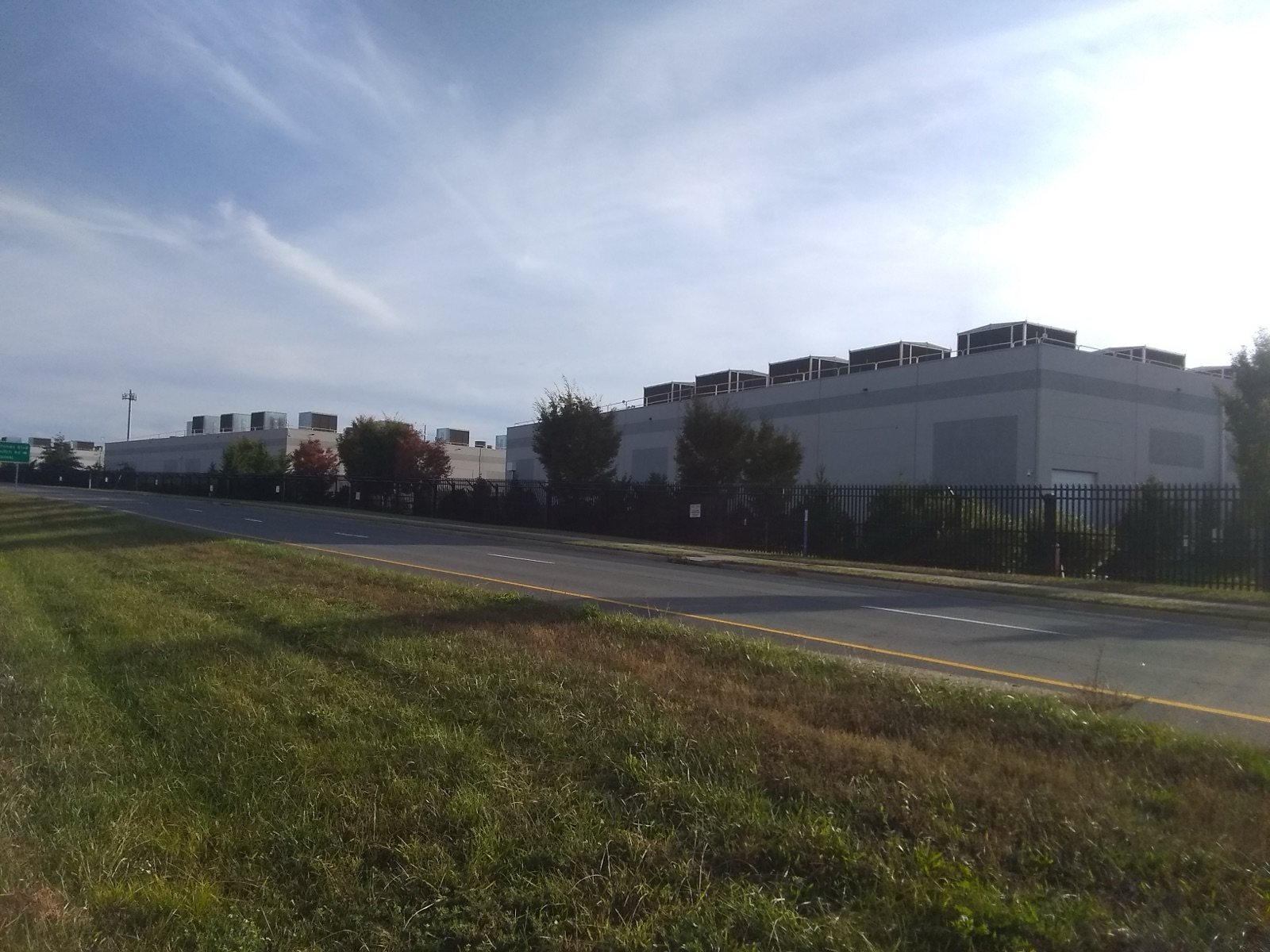
Your email runs through one. So does your bank, your maps, your streaming, your doctor’s records, and the app you just used to send a photo to your kids. When people say “the cloud,” this is the cloud. And these buildings aren’t new. They just weren’t always tied to AI. Companies have been filling rooms with servers for decades. It may be that “the cloud” was too good a name, because a lot of people pictured their information floating somewhere up in the sky and reaching them by satellite. In a 2012 survey for Citrix, 51 percent of Americans said stormy weather could interfere with cloud computing. It was never weightless. It was always a building somewhere, connected by cables. Even between continents, more than 99 percent of the data travels through cables on the ocean floor, according to TeleGeography, a firm that tracks them.
By now, I think a functioning economy depends on them. We got a small reminder in October of last year, when a software failure inside one Amazon cloud region in Northern Virginia knocked out or slowed down services around the world, including banking apps, Venmo, Snapchat, and Zoom. Amazon says the event lasted about 14 hours. That was one failure, in one region, and it got fixed. I don’t know how you run a modern bank, airline, or hospital without these buildings.
The newer ones are mostly being built for AI, and I’ll be honest about my bias here, because these are the tools I use every day. OpenAI said in August that ChatGPT had passed a billion weekly users, and Google said the same month that its Gemini app had passed a billion monthly users. People can disagree about whether that’s a good thing, but it isn’t a fad, and the computing behind it has to live somewhere.
There’s also a bigger picture. Someone opposed to data centers might say, fine, let them get built somewhere else. And distance barely matters for most of what I do; a data center on another continent adds a fraction of a second. But that’s exactly why these buildings can leave so easily, and the tax revenue and construction jobs would leave with them. The computing would also be running on someone else’s soil, under someone else’s rules. The U.S. already limits which countries can buy its most advanced AI chips, because it treats computing power as strategic. My guess is the next decade of that computing goes into medicine and science, and I’d rather we be in the middle of it than renting time from the sidelines.
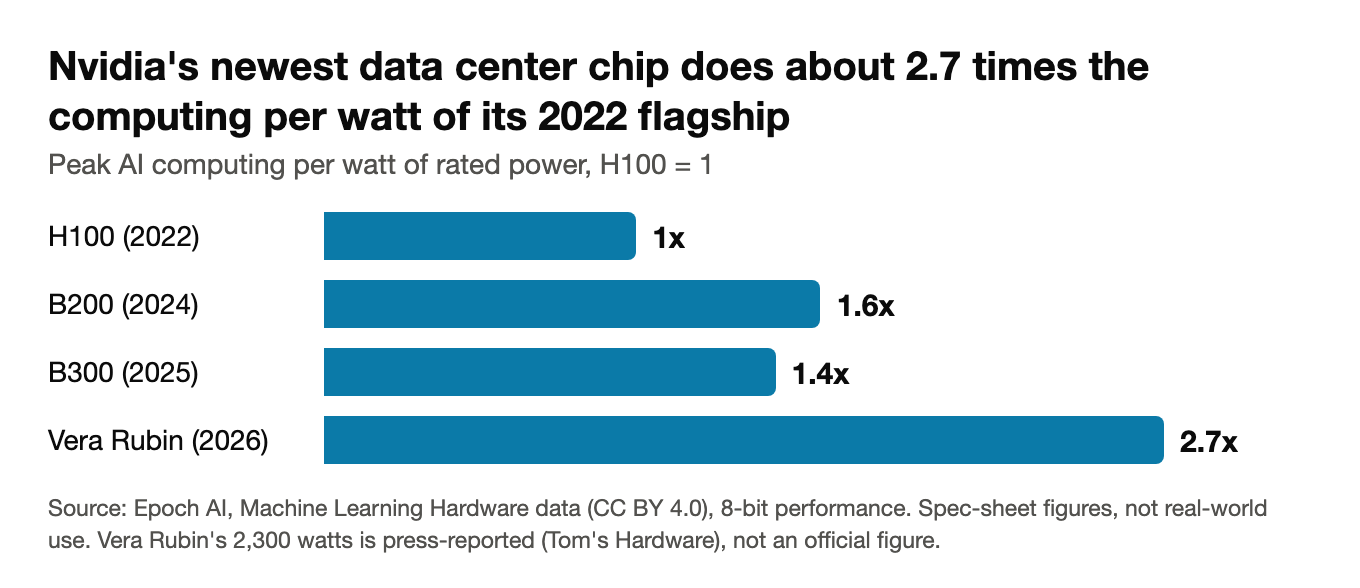
The efficiency gains are also easy to miss. For years they nearly kept up with demand: between 2010 and 2018, according to a study in the journal Science, the amount of computing done in the world’s data centers grew by about 550 percent, while the energy they used grew by only about 6 percent. The AI buildout ended that, and U.S. data center electricity use more than doubled between 2018 and 2023. But the gains themselves haven’t stopped. Epoch AI, which tracks this, says the energy efficiency of AI hardware has been improving by roughly 40 percent a year, and Google reports that the energy for its median Gemini prompt fell 33-fold from May 2024 to May 2025. A lot of very smart engineers have spent a long time making these buildings do more with less. The demand is simply growing faster.
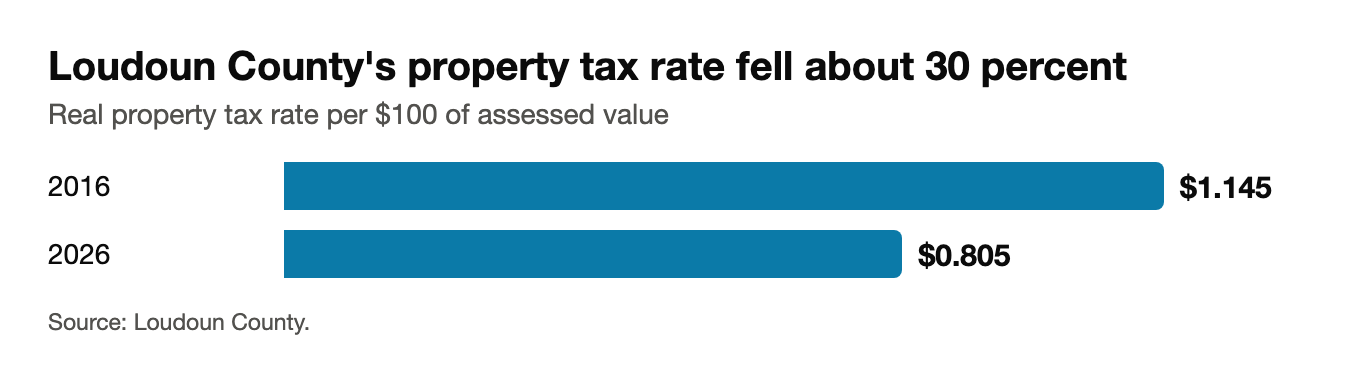
Then there’s the money they bring to the towns that host them. Loudoun County, Virginia, which happens to be where I lived before I moved to Florida, has one of the largest concentrations of data centers in the world. The county’s own budget documents show data centers now bring in about 40 percent of its General Fund revenue, and the county says that revenue “enabled the county to generally lower the real property tax rate for homeowners every year for the past decade.” The rate went from $1.145 per hundred dollars of value in 2016 to $0.805 this year. Home values went up over the same period too. And the people who build these places have noticed what a ban would cost them: the electrical workers’ union has been campaigning against moratoriums in New England, warning that they “threaten to block billions of dollars in potential investment.”
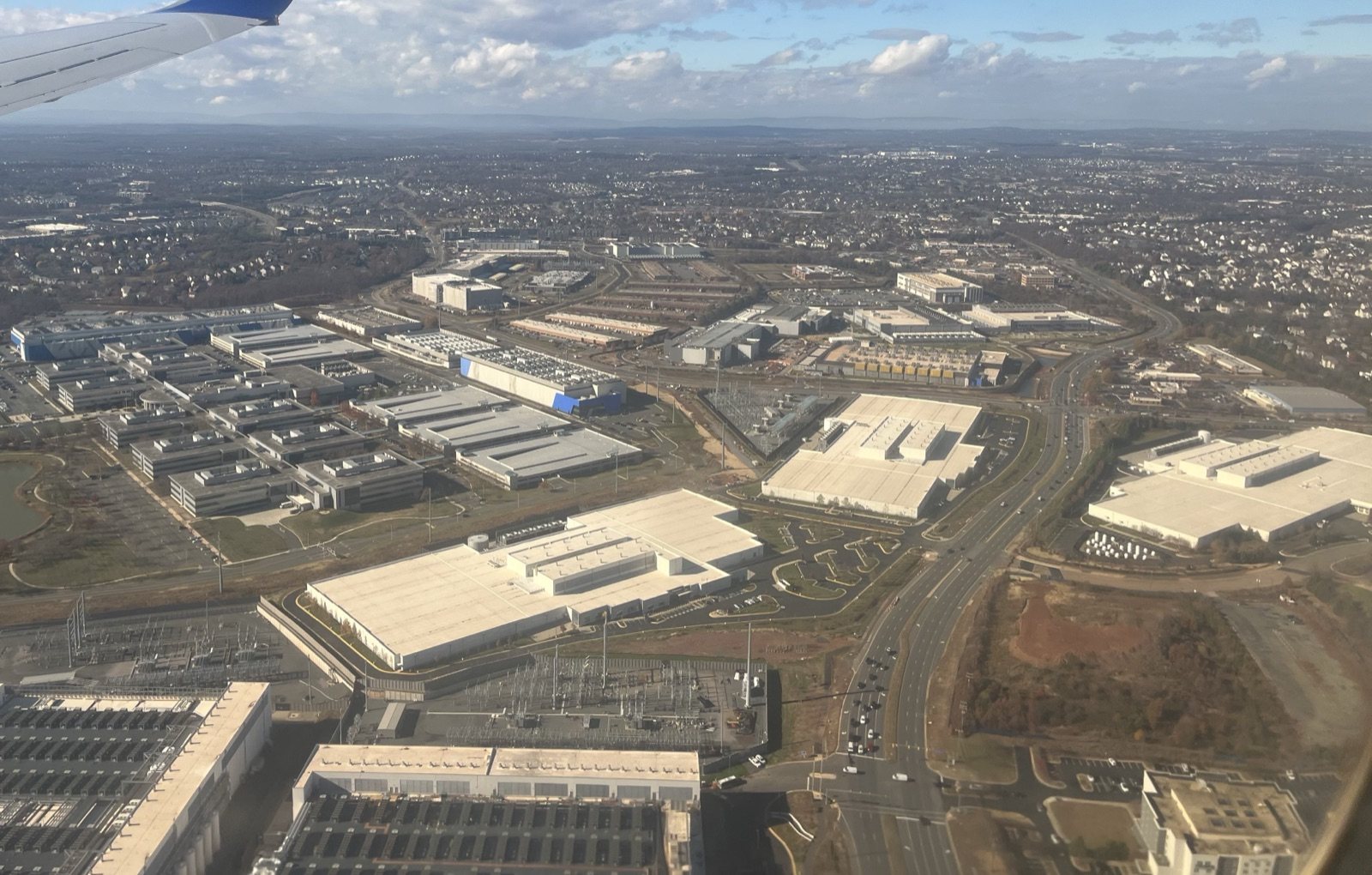
None of that shows up in a video that opens with “Data centers are stupid.”
The concerns, conceded
So what do people actually believe? A poll by Echelon Insights in June asked voters which statements about data centers they thought were true.
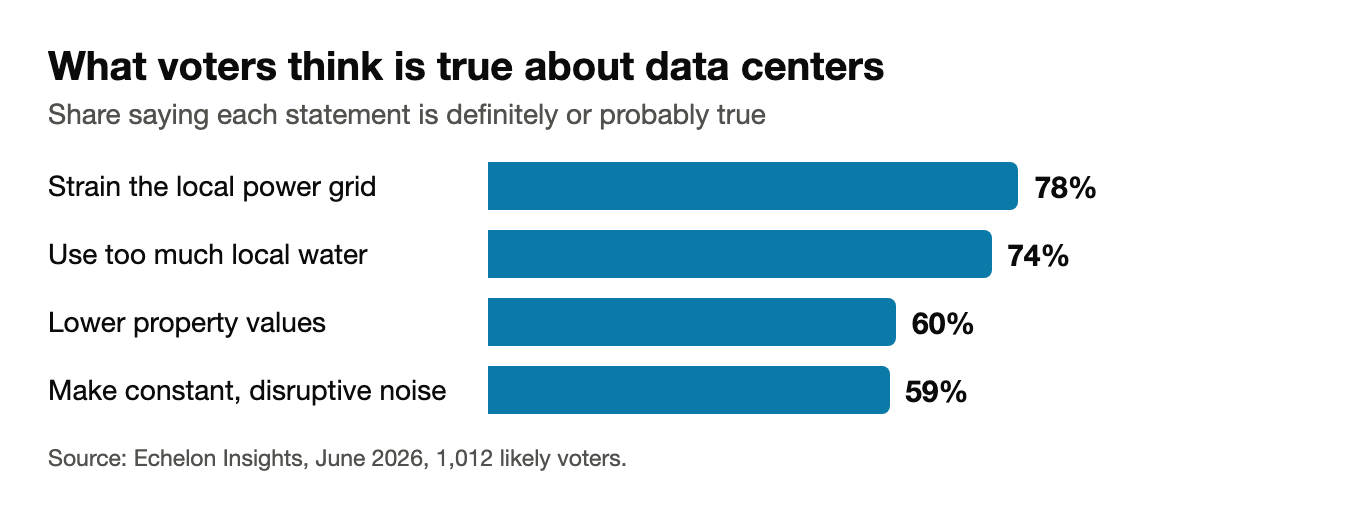
I think the early concerns were mostly justified. In some parts of the country, power bills went up and people were told data centers were part of the reason, and in at least one big region they were. Some sites were built in places that are already short on water. Some sit close enough to homes that the hum from the cooling equipment carries at night. I recently caught a TV report from Northern Virginia where a man stood with a reporter outside a data center across the street from his house, and you could definitely hear an annoying hum. And a lot of these deals were made quietly, with nondisclosure agreements and very little public notice, which is about the fastest way I know to make people assume the worst.
So let me take them one at a time.
Water
I’ve been telling people that golf courses use more water than data centers do. Then I checked.
In total, it holds up. The golf industry’s own survey says U.S. courses put down roughly 531 billion gallons of water in 2024. Lawrence Berkeley National Laboratory, in a report for the federal government, put the water used for cooling at every data center in the country in 2023 at about 17 billion gallons. By that measure, golf uses about thirty times more.
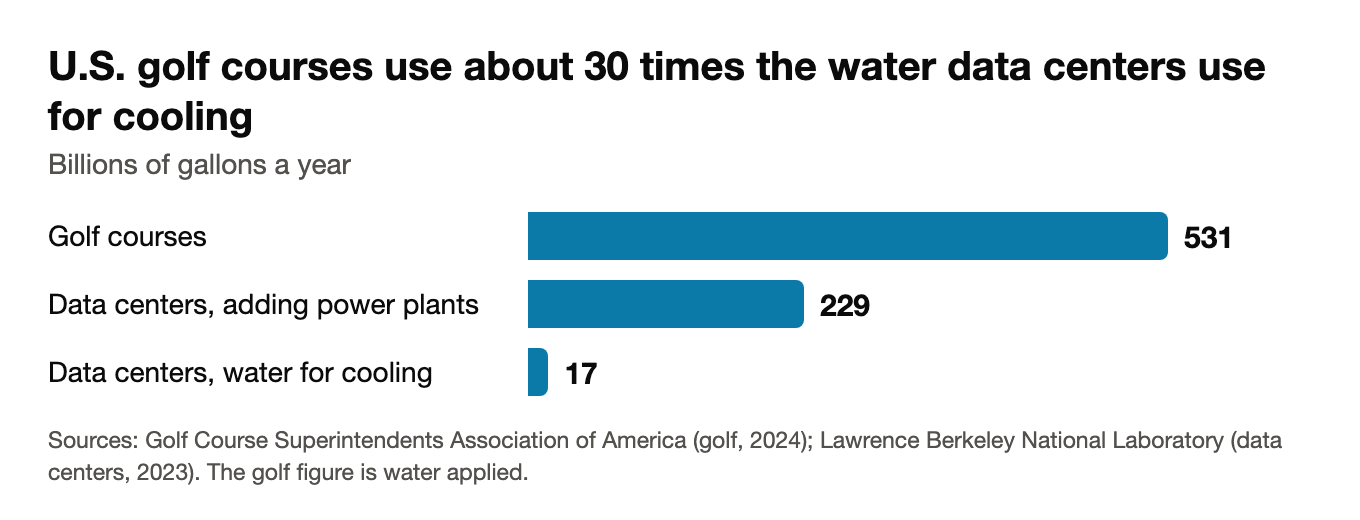
To be fair, there’s a second way to count. Power plants use water too, and if you add the water used to generate the electricity data centers consume, their total comes to about 229 billion gallons. Golf still uses a little more than twice as much. I’d rather give you both numbers than have someone point out the one I left out. And the country has about 14,000 golf facilities. I haven’t seen a petition to shut them all down.
The newest designs use far less, and some use almost none. Microsoft says that since 2024, all of its new data center designs use zero water for cooling, at the cost of a small increase in energy use. So why doesn’t everybody do that? Because it’s a trade. Evaporating water is one of the most energy-efficient ways to cool a building, so going without it generally means using more electricity, and generating that electricity takes water too. Microsoft’s design is also for new buildings, and the first sites aren’t due to come online until late 2027. Where water is plentiful, operators have less reason to switch. Where it isn’t, rules can make them: Southern Nevada banned evaporative cooling in new commercial and industrial buildings in 2023.
But I want to be careful here, because the total isn’t shrinking. The buildout is growing faster than the efficiency gains, and the same federal report expects average water use per unit of electricity to rise for a few years as more liquid-cooled AI servers come online. And national averages don’t help a small town in a dry region if the one big data center happens to be built there. Water is a real issue in specific places. I don’t think it’s a national crisis.
Power
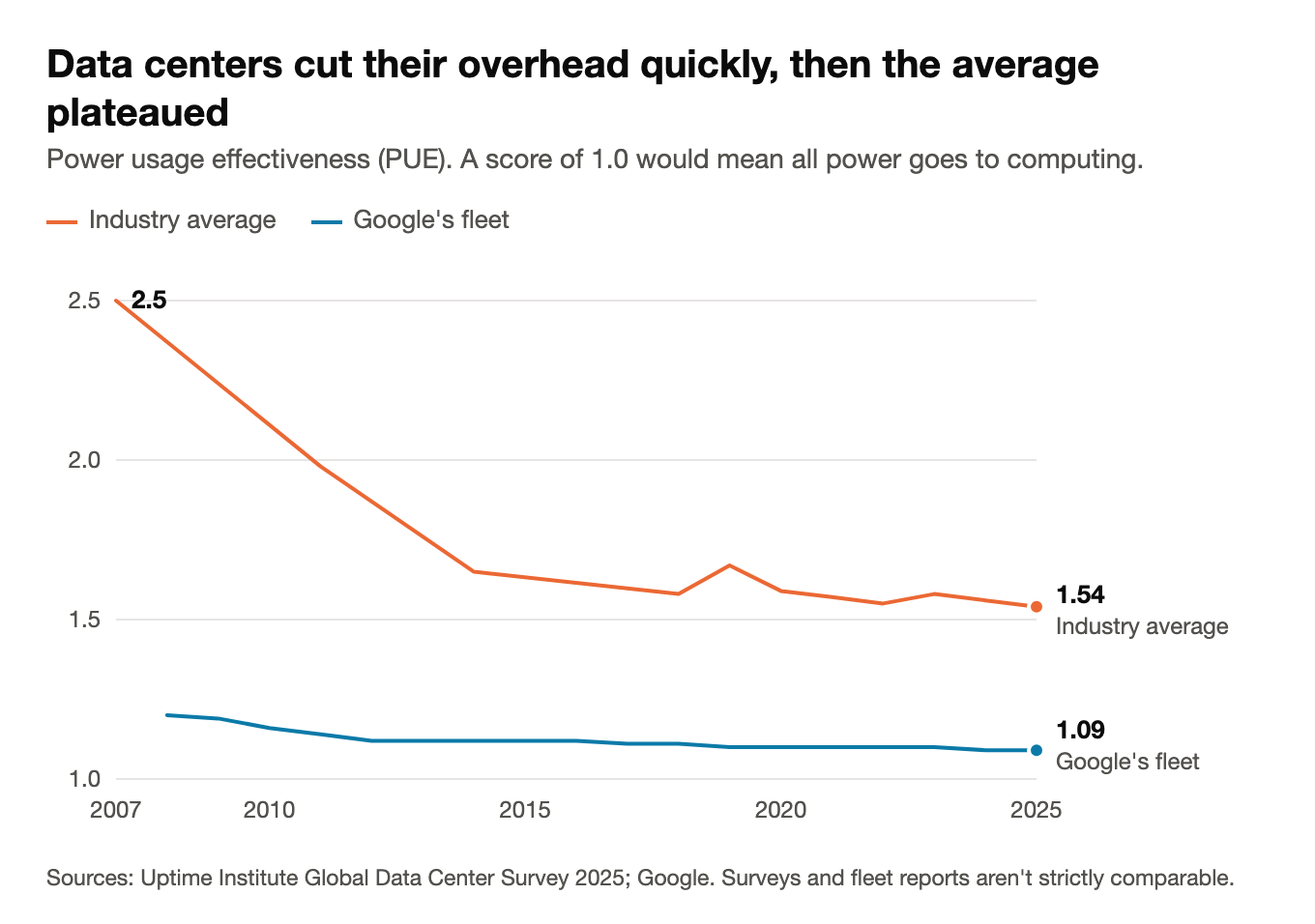
The data center industry measures waste with a number called power usage effectiveness. A score of 2.0 means that for every watt running the computers, another watt goes to cooling and overhead. In 2007, the industry average was about 2.5. By 2014 it was about 1.65. Since then the average has been mostly flat, around 1.55, but the best-run operators are far below it. Google reports its fleet at 1.09, which means less than 10 percent of its power goes to anything besides computing.
The honest part is the scale. Data centers used about 4.4 percent of the country’s electricity in 2023, about three times what they used in 2014, and the Berkeley Lab report projects somewhere between 6.7 and 12 percent by 2028. That’s a lot of new demand in a short time, and it’s the one concern on this list that I’d call solvable rather than easy. It means new generation, new transmission lines, and a lot of planning by people who usually move slowly. This month, OpenAI announced a program in which its future campuses would cut their power use when the grid is strained, starting with up to 1 gigawatt at a planned campus in Georgia. Beyond that Georgia agreement, OpenAI calls the program an ambition, so for now it’s a promise, not proof.
Who pays for it
This is the objection I think was most valid, and it’s worth explaining why.
For a long time, when a utility had to build new power plants, lines, or substations, the cost was spread across all of its customers. That made sense when growth came from a growing population, on the premise that society benefits from a growing community. Researchers at Harvard’s Electricity Law Initiative note that “data centers are upending this long-standing model.”
They are, because a single data center can require a new substation and transmission lines for one customer. In Virginia last year, regulators approved a substation and line estimated at about $23 million for a single proposed data center, with the cost recovered from ratepayers in general. In Wisconsin, the regional transmission company expects to spend more than $500 million upgrading the grid connection for one Microsoft data center campus. Spreading costs like that over every household in the service area never made much sense, and people noticed.
The good news is that the rules are changing, state by state. In Ohio, regulators approved a rule for the utility AEP Ohio in July 2025 that requires new data centers over 25 megawatts to pay a minimum of 85 percent of the capacity they sign up for, whether they use it or not, for up to twelve years. Georgia adopted a rule in January 2025 for very large customers; in its own words, “data centers will need to bear the cost of their electricity acquisition.” Virginia created a new rate class for data centers with minimum charges and fourteen-year contracts, and Texas enacted a law in June 2025 making large users share grid costs and allowing them to be cut off in a grid emergency.
Has any of this raised household bills? The evidence goes both ways. Berkeley Lab looked at electricity prices from 2019 to 2025 and found that states with growing demand tended to see lower prices, not higher, with data centers included. The logic is that a grid’s fixed costs get divided across more electricity sold. It also added a warning: “Past need not be prelude.” The mid-Atlantic shows why. Utilities there pay in advance to reserve enough power plant capacity for future demand, and the region’s own market monitor found that data center demand was the main reason that cost jumped by billions of dollars in recent auctions. So the honest answer is that it depends on where you live, and the rules in most places are still catching up. Many counties and states are scrambling to change them so they fit today’s realities, which is exactly what should be happening.
Ten miles from my house
Last year, a developer proposed a large expansion of a commerce park in western Palm Beach County, about ten miles from where I live. They called it Project Tango. The site had been approved back in 2016 for warehouses and a modest data center. The expansion would have added a much larger one.
It drew a lot of anger. The county’s zoning commission recommended against it, and in July, after about twelve hours of public debate, the county commission voted it down 5 to 1. The developer has appealed, and that fight is still going. The county has since paused new applications for large data centers for up to a year while it writes rules.
My own reaction at the time was a question. Why would anyone build a data center in hurricane country? A big enough storm could take out the power grid for weeks. I wasn’t opposed to it. But then again, I don’t live right next door to where it was going to be.
I looked into the hurricane question since, and the answer says something about how much engineering goes into these buildings. When the grid fails, batteries carry the load for the first few seconds, and diesel generators take over within about ten. Facilities in storm country keep days of fuel on site and have priority delivery contracts for more. Things can still go wrong, and several data centers in Lower Manhattan went dark during Hurricane Sandy in 2012. The industry learned from it. And the big operators don’t rely on any single building. When a hurricane is coming, they can shift the work to data centers in other states, days ahead.
Here’s the part of the Project Tango story that I didn’t expect. In October, county staff approved a smaller version of the data center, using space left over from the 2016 approval. This time it came with conditions. No data center buildings within 850 feet of the property line next to the neighborhood. Noise capped at 50 to 60 decibels depending on the time of day, with continuous monitors the county can check. Water from the county utility capped at 100,000 gallons a day for the entire site. That water cap comes to about 36 million gallons a year, which is roughly what one golf course uses.
Those decibel numbers meant nothing to me until I downloaded a sound meter app. At my desk with the doors and windows closed and my dog sleeping quietly a few feet away, it read 41. A few feet from the small waterfall between my jacuzzi and pool, it read about 66, and I could easily talk over it. So a limit of 50 to 60 decibels is quieter than that. A steady hum at night is a different kind of sound, I haven’t stood next to a big data center myself, and a phone isn’t a lab instrument, but I think it gives you a sense of scale.
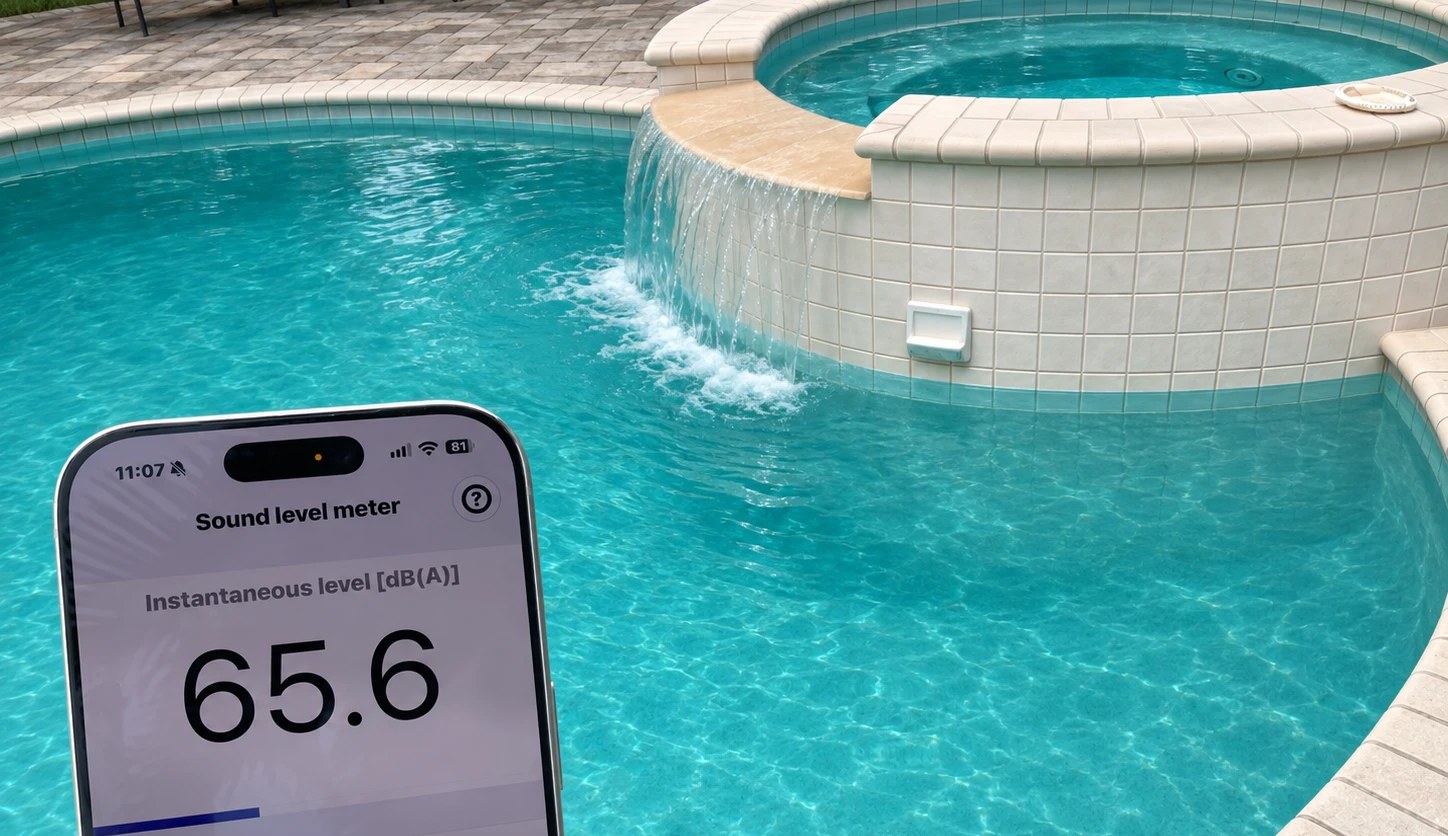
That is almost exactly what I would have asked for. Build them like any other warehouse: in an industrial area, with a real buffer between them and anyone’s bedroom.
There are plenty of businesses you wouldn’t want next door: sewage treatment plants, landfills, rendering plants, refineries. We need all of them, and they operate all across the country. Making sure they have somewhere to operate without disturbing a residential neighborhood is a big part of what city planners and zoning commissions are for. I don’t think data centers rank very high on that list of awful neighbors. Putting a business in an appropriate location is far different from “I want them gone.”
The neighbors are still angry, and I understand why. The October approval happened without a public hearing, and many of them found out after the fact. The rules were reasonable. The closed door was the problem.
Why the facts aren’t moving anyone
If the fixes exist, why hasn’t opinion moved? I think the honest answer is that facts aren’t what changed people’s minds in the first place.
People are generally well-meaning, but I think we all have some herd in us. These days, many people identify with a position, and changing it can feel like having part of your identity stripped away. We’ve even made changing your mind an insult: politicians call it a flip-flop. In my view, flipping when you get new information is a sign of intelligence. Some research suggests that a correction can change what people believe about a fact without changing where they stand, which sounds about right to me.
Take water. In June, Echelon Insights read voters this statement: “The false idea that data centers use excessive water is based on a massive mathematical error that has now been acknowledged and corrected by its author.” Eight percent found it very convincing. Twenty percent found it somewhat convincing. The rest didn’t, or weren’t sure.
Part of that is trust. Gallup found this summer that confidence in large technology companies has fallen to a new low, about one in five Americans. Part of it is feeling like nobody asked. When decisions about a building the size of a shopping mall get made behind nondisclosure agreements, people stop believing anything the builders say, even when it’s true.
I also think some of this anger isn’t really about the buildings. A while back, a friend asked what I was doing these days. I told her I was building software and was quite involved with AI. Her immediate comment was, “Wow, you must be really rich now.” I think that says something. To a lot of people, AI means a few very rich people getting richer. But a data center is something you can actually vote against. It has a zoning hearing and a county commission. My guess is that some of the anger at the people at the top lands on the building, because the building is the only part within reach.
And to be fair, the AI industry has not helped itself. In October, OpenAI’s CEO, Sam Altman, was asked on a Politico podcast how his views on regulation differ from those of his competitor at Anthropic. Part of his answer was this: “We believe that the world should accept some bad things happening for the benefits of this technology and people having the agency.”
That sentence went everywhere. What went with it much less often was the rest of his answer. The “bad things” he meant were hacks, misuse and scams. And he drew a line: “Accept bounded risks,” he said, but “don’t accept, like, the really catastrophic risk.”
I think that’s a defensible position. But he said it in a sentence practically built to become a headline. People who run these companies have been tone-deaf about how they say things, and every one of those sentences makes the next data center harder to build. OpenAI has started calling its sites “compute campuses.” I don’t think a new name is going to fix this.
Where people actually are
Here’s the part of the polling that gets less attention. When Morning Consult asked voters in July to choose between two approaches, 57 percent picked clear rules that require transparency, community input, and protection against higher electric bills while allowing responsible data centers to be built. Twenty-three percent picked a moratorium on all new data centers. Seventy-eight percent supported making the companies pay for the grid upgrades their projects need, rather than passing those costs on to residents. (The poll was commissioned by a group that works on AI policy, which is worth knowing.)
So the loudest position in this debate isn’t actually where most people are. Most people want the building done right, in the right place, paid for by the people who profit from it. That’s almost exactly what the commentator’s petition, the one I described at the start, asks for in writing. It isn’t what his video asks for.
Then came Election Day. Data centers were on local ballots in 10 states this month, and restrictions won almost everywhere. Of the 41 local measures Ballotpedia tracked, the side favoring limits won all but one. I don’t want to wave that away. Several of those votes were about one specific site, and some were outright bans. My guess is that when a pollster asks, people say they want rules, and when it’s the lot down the road, they say no. I think both can be true, which is exactly why where these go and who gets a say matter so much.
Nobody’s backyard
One more thing, because it made me smile. Google is testing whether data centers can work in orbit, where a solar panel can produce up to eight times as much power as it would on Earth, with no neighbors and no water needed for cooling. In October, it launched a small prototype satellite, and engineers on the ground asked the model on board for a haiku about being in space. Google wrote up the moment here. Google isn’t alone. A startup called Starcloud put one of Nvidia’s data center chips into orbit last year, and SpaceX has asked federal regulators for permission to launch up to a million satellites for this purpose.
It’s a long way from a working data center. Space is cold, but with no air to carry heat away, cooling takes large radiators. Radiation is a problem, launches are expensive, and nobody can drive out to swap a broken GPU. But I like the idea. The ultimate answer to “not in my backyard” may turn out to be nobody’s backyard at all.
Not on the first five pages
I don’t think data centers are harmless. I think they’re buildings, big ones, with real costs that have real fixes: put them where warehouses go, make them pay for the grid they need, cap the water and the noise, and decide in public instead of behind closed doors. Most of the country seems to agree with that when you actually ask. These problems are quite solvable. Abolishing the industry isn’t the solution.
A pause isn’t a plan. It just postpones the decision, and it leaves the hard questions exactly where they were. Meanwhile, almost everything we do online (including reading this essay), and a lot of what will make the next decade better, depends on these buildings existing somewhere.
I could be wrong about some of this, mostly because this technology is growing and changing very quickly. A week after this gets published, some of the information could already be out of date. But of everything on the list of things this country should be worried about right now, my guess is that data centers wouldn’t make it onto the first five pages.
Photos: Ashburn street view by Vahurzpu, CC BY-SA 4.0; Ashburn aerial view by Theodore Christopher (public domain). Chip efficiency data: Epoch AI, CC BY 4.0. Header image created with ChatGPT. Charts by the author; sources are listed on each chart.